
Why Your Handyman Career Is More Secure Than a Programmer's: The AI-Proof Trade
The Irony Nobody’s Talking About
While white-collar workers are losing sleep over ChatGPT writing their reports and AI replacing their desk jobs, you—the person who fixes leaky faucets and hangs drywall—are sitting on one of the most recession-proof, AI-proof, future-proof careers on the planet.
Let that sink in.
The accountant? AI can do their job. The graphic designer? Midjourney is coming for them. The programmer? GitHub Copilot is already writing half their code. The customer service rep? Replaced by chatbots.
But the handyman who can diagnose why a door won’t close, rewire a light fixture, and patch drywall so it’s invisible?
That job isn’t going anywhere. Ever.
Here’s why your calloused hands and problem-solving brain are worth more than a computer science degree in 2025—and why that gap is only getting bigger.
The Five Reasons AI Can’t Touch Your Handyman Career
1. Physical Reality Doesn’t Upload to the Cloud
AI is brilliant at processing information. It can write code, analyze data, create images, even diagnose diseases from X-rays.
But here’s what it can’t do: exist in physical space.
A robot can’t:
- Navigate a cluttered basement to find the water shutoff valve
- Feel that a door hinge is slightly bent and needs shimming
- Smell the electrical burning behind a wall
- Improvise when the “standard” solution doesn’t fit the actual problem
- Carry a 200-pound vanity up a narrow staircase with a 90-degree turn
Physical work in unpredictable environments is AI’s kryptonite.
Every house is different. Every repair has unique constraints. Every customer has different needs. There’s no algorithm for “figure it out”—but that’s what you do every single day.
Boston Dynamics can make a robot do backflips, but they can’t make one that can reliably replace a wax ring on a toilet in a 1920s bathroom with non-standard plumbing. And they won’t be able to for decades, if ever.
2. The “Last Mile Problem” Is Insurmountable
In logistics, there’s something called the “last mile problem”—it’s easy to get a package 99% of the way there, but that final delivery to your doorstep is the most expensive, complicated part.
Handyman work IS the last mile problem, every single time.
Think about it:
- AI can tell you HOW to fix a leaking pipe (YouTube already does this)
- AI can order the parts for you
- AI can create a step-by-step guide
- AI can even diagnose the problem from a photo
But AI can’t:
- Drive to the customer’s house
- Navigate their specific environment
- Assess the actual situation (which is always different from the description)
- Use physical tools with human dexterity and judgment
- Clean up and ensure the customer is satisfied
The diagnosis might be automated. The physical execution? That’s all you.
And here’s the thing: that last mile—the actual physical work—is worth MORE than all the other steps combined. That’s why you get paid $125-150 an hour while the AI gets nothing.
3. Human Judgment Beats Algorithms Every Time
You arrive at a job. The customer says their door won’t close.
You look at it for 30 seconds and know:
- The foundation settled
- The door frame shifted
- Simple fix: plane the door, adjust the hinges
- But you also notice the crack in the ceiling
- And the window that looks slightly off
- Foundation issue is bigger than they realize
That’s pattern recognition, systems thinking, and human judgment happening simultaneously in real-time.
An AI could be trained to recognize door problems. But it can’t:
- Read the customer’s body language to gauge their budget
- Decide whether to mention the foundation issue or just fix the immediate problem
- Improvise when the “textbook solution” doesn’t work
- Balance speed, quality, and cost based on the situation
- Build trust with a worried homeowner
Context matters. Nuance matters. Judgment matters.
These are inherently human skills that can’t be reduced to code—at least not in any foreseeable future.
4. The Trust Factor: Humans Hire Humans
Even if—and this is a massive if—robots could physically do handyman work, there’s a psychological barrier that won’t be crossed in our lifetime:
Nobody wants a robot in their home unsupervised.
Think about what you do:
- You enter people’s most private space—their homes
- You’re alone in their house while they’re at work
- You have access to their belongings, their layout, their valuables
- You’re working on systems that could burn their house down if done wrong
This requires TRUST. Deep, human trust.
Homeowners hire handymen they can look in the eye, talk to, and trust. They want someone who:
- Shows up when promised
- Explains what’s wrong in plain English
- Makes them feel comfortable
- Guarantees their work personally
- Can be held accountable
A robot or AI system can’t build that relationship. And without that relationship, the transaction doesn’t happen.
You’re not just providing a service—you’re providing peace of mind. That’s a fundamentally human-to-human value exchange that technology can’t replicate.
5. The Economics Don’t Make Sense (And Never Will)
Let’s play devil’s advocate and imagine a world where robots COULD do handyman work.
Here’s the problem: it would be absurdly expensive and impractical.
Consider what a “handyman robot” would need:
- Advanced computer vision (recognize problems in messy, varied environments)
- Complex manipulation (use 50+ different tools with human-like dexterity)
- Navigation (move through homes without breaking things)
- Problem-solving AI (handle non-standard situations)
- Maintenance and updates (constant repairs and software patches)
- Liability insurance (who’s responsible when the robot breaks something?)
Cost to develop: Hundreds of billions of dollars Cost per unit: Probably $500,000-1,000,000+ Maintenance: Constant, expensive
Now compare that to… hiring you.
You show up with $5,000 worth of tools, decades of experience compressed into pattern recognition, and the ability to solve problems the robot’s programmers never anticipated.
You’re cheaper, more reliable, and more capable than a billion-dollar robot will ever be.
The economics don’t work. They never will. Labor is expensive, but robot labor in unpredictable physical environments is exponentially MORE expensive.
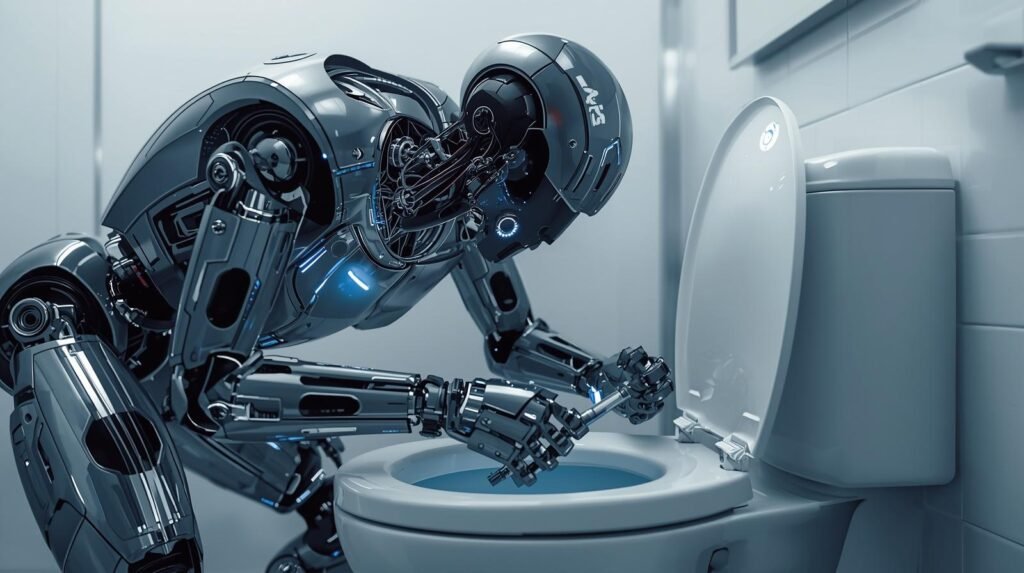
But Wait—Won’t Automation Still Hurt the Trades?
Here’s the twist: automation will actually HELP handymen.
Not hurt. Help.
Here’s why:
Technology Creates MORE Work, Not Less
Every new “smart home” gadget creates new problems:
- Smart thermostats need installation
- Smart locks need troubleshooting
- Ring doorbells need mounting and WiFi setup
- Smart switches need rewiring
- Home automation systems need integration
Who does all this work? You.
The more technology enters homes, the more things break, need updating, need installing, need fixing.
DIY Is Dying
YouTube makes it LOOK like everyone can do everything themselves. But here’s what actually happens:
- Homeowner watches YouTube tutorial
- Homeowner tries DIY repair
- Homeowner makes it worse
- Homeowner calls you in a panic
- You charge extra to fix their fix
AI tutorials don’t replace you—they create more work for you.
Every “easy DIY project” AI suggests creates three handyman jobs when it goes wrong.
The Skilled Trades Shortage Is Real
Here’s the reality nobody’s talking about:
- Average age of tradespeople: 55+
- Millions retiring in the next decade
- Younger generation not entering trades (they’re getting useless degrees)
- Demand for home repairs only increasing
There’s already a massive shortage. AI isn’t competing with you—it can’t fill the gap you’re in.
In 10 years, skilled handymen will be able to charge whatever they want because there won’t be enough of you to meet demand.
The Skills That Make You Irreplaceable
Let’s break down exactly what makes your job impossible to automate:
1. Multi-Domain Expertise
You need to know plumbing, electrical, carpentry, drywall, painting, flooring, HVAC basics, appliance repair, and more. That’s 10+ specialized fields.
An AI would need to be trained on all of these, then execute physically in all of them. Not happening.
2. Adaptive Problem-Solving
Every job is different. The fix that worked last time might not work this time. You adapt in real-time based on what you find.
AI is terrible at novel situations. You excel at them.
3. Physical Dexterity
You use hammers, drills, saws, levels, wrenches, screwdrivers, and dozens of other tools—often in tight spaces, awkward angles, and uncomfortable positions.
Robotics researchers have spent billions trying to replicate human hand dexterity. They’re nowhere close.
4. Contextual Intelligence
You read situations:
- This customer wants the cheapest fix
- This customer wants it perfect
- This job is urgent
- This one can wait
- This customer will refer me to friends
- This one is a one-time transaction
AI can’t read a room. You can.
5. The BS Detector
You know when:
- A customer is lying about what happened
- A previous handyman cut corners
- A “quick fix” will become a big problem later
- Someone is trying to lowball you
- A job isn’t worth your time
This is wisdom. Experience. Pattern recognition built over years. No algorithm can replicate that.
The Future Is Bright for Handymen (Seriously)
While everyone else worries about AI taking their jobs, here’s what’s actually happening in the trades:
Rising Wages
Demand up, supply down = you charge more. Simple economics.
Handymen who were getting $40/hour five years ago are now charging $125-150/hour. And customers are paying it because they have no choice—there aren’t enough skilled tradespeople.
Respect Is Returning
For decades, society pushed “everyone needs a college degree.” Result: millions of debt-laden grads working at Starbucks.
Now people are realizing: the plumber makes more than the philosophy major. And the plumber has no debt.
Respect for skilled trades is coming back. Parents are encouraging kids to learn trades. Society is waking up to the value of physical skills.
Technology Makes You MORE Valuable
Apps make scheduling easier. GPS finds you customers. YouTube teaches you new techniques. Power tools make you faster.
Technology isn’t replacing you—it’s making you more efficient and profitable.
The “Laptop Class” Envy
All those people working remote jobs from their couch? They’re scared. Their jobs CAN be automated. Their salaries are being compressed by global competition and AI.
Meanwhile, you have:
- Skills that can’t be outsourced to India
- Work that can’t be done by AI
- A career that requires physical presence
- The ability to set your own prices
- Freedom to work for yourself
You’re more secure than 90% of white-collar workers. They’re just too proud to admit it.
What This Means for Your Career
If you’re a handyman, or thinking about becoming one, here’s your reality:
Not despite AI and automation—but BECAUSE of it.
While the world automates information work, physical work becomes MORE valuable, not less.
The Next 20 Years Will See:
✅ Increasing demand (aging housing stock, more homeowners, retiring tradespeople)
✅ Rising prices (scarcity of skilled labor, inflation, material costs)
✅ Better technology (tools that make you faster and more capable)
✅ More respect (society recognizing the value of trades)
✅ Greater autonomy (ability to run your own business, set your own terms)
✅ Job security (skills that literally cannot be automated)
Your career is more secure than a doctor’s, lawyer’s, or engineer’s. Because while AI might diagnose diseases, argue legal cases, and design buildings, it can’t fix a leaky pipe in a 100-year-old house with non-standard plumbing.
.

The Bottom Line: Physical Reality Always Wins
Here’s the uncomfortable truth that tech evangelists don’t want to admit:
The physical world is hard. Really, really hard.
Bits are easy. Atoms are hard.
- Moving information? Easy. (AI dominates)
- Moving matter? Hard. (Humans still reign)
- Analyzing data? Easy. (AI dominates)
- Installing a toilet? Hard. (Humans still reign)
- Writing code? Increasingly easy. (AI getting better)
- Fixing a door that won’t close? Still hard. (Humans unmatched)
As long as humans live in physical houses with physical plumbing, electrical, and structural systems, they will need physical humans to fix physical problems.
That’s you.
Your career isn’t just safe from AI—it’s one of the MOST secure careers in the modern economy.
What You Should Do With This Information
Now that you know you’re in an AI-proof, recession-proof, future-proof career, here’s what to do:
1. Invest in Your Skills
Learn new trades, master your current ones, stay updated on technology. The better you are, the more you can charge.
2. Build Your Business
Don’t just trade hours for dollars. Build systems, raise prices, create multiple revenue streams. You’re not just a handyman—you’re a business owner.
3. Charge What You’re Worth
Stop competing with the cheap guys. Position yourself as premium. Your skills are rare and valuable—price accordingly.
4. Embrace Technology (As a Tool)
Use apps for scheduling, GPS for routing, YouTube for learning, social media for marketing. Technology makes you BETTER, not obsolete.
5. Take Pride in Your Work
You have skills that took years to develop and can never be automated. That’s worth celebrating.
The Final Word: You’re Not Just Safe—You’re Winning
The future belongs to people who can DO things in the physical world.
While everyone else is worried about AI taking their jobs, you should be confident in yours.
You fix real problems. You work with your hands. You create tangible value. You can’t be outsourced, automated, or replaced.
You’re not competing with AI. You’re irreplaceable.
So the next time someone suggests you should “learn to code” or “get a real job,” just smile.
Because while they’re worried about ChatGPT writing them out of relevance, you’re getting paid $150/hour to do work that no robot, algorithm, or AI will ever be able to do.
Your hands built civilization. They’re not going obsolete anytime soon.
Now get back to work. Someone’s toilet is leaking, and no AI on Earth can fix it.